The Myth: Bread Eaters in Shanghai
This past summer I joined NYU Steinhardt on a nearly three week long Global Food & Cultures: Shanghai course. I must admit that it was impossible for me to enter without my preconceived notions and perspective baggage. However, this being my third immersive travel academic course of this type, I admit I also knew that I understood next to nothing about the realities of the culture(s) that I was about to observe (with each of my senses), experience, and analyze for the weeks to follow. When I was growing up as a child, my favorite movie was Disney’s Mulan, set in China. I watched that VHS so frequently until my eldest brother ended up hiding it on me so that he wouldn’t have to listen to it anymore. As this childish version of myself focused on this movie, I remembered the featured dishes like the rice porridge (what I now know to be congee) that Mushu prepares for Mulan before her first day in the army, the full community pot of rice that Mulan spills which had been meant to feed the Chinese army men, and even the rice and meat that the army men fantasize about during their training. What stood out to me in memory is the connection of rice as a staple food in the Chinese diet. While this is largely the case throughout much of China, other regions and Chinese subcultural groups enjoy ingredients, flavors, and dishes that seem to standout amidst a land of what I had understood to be all rice-eaters.
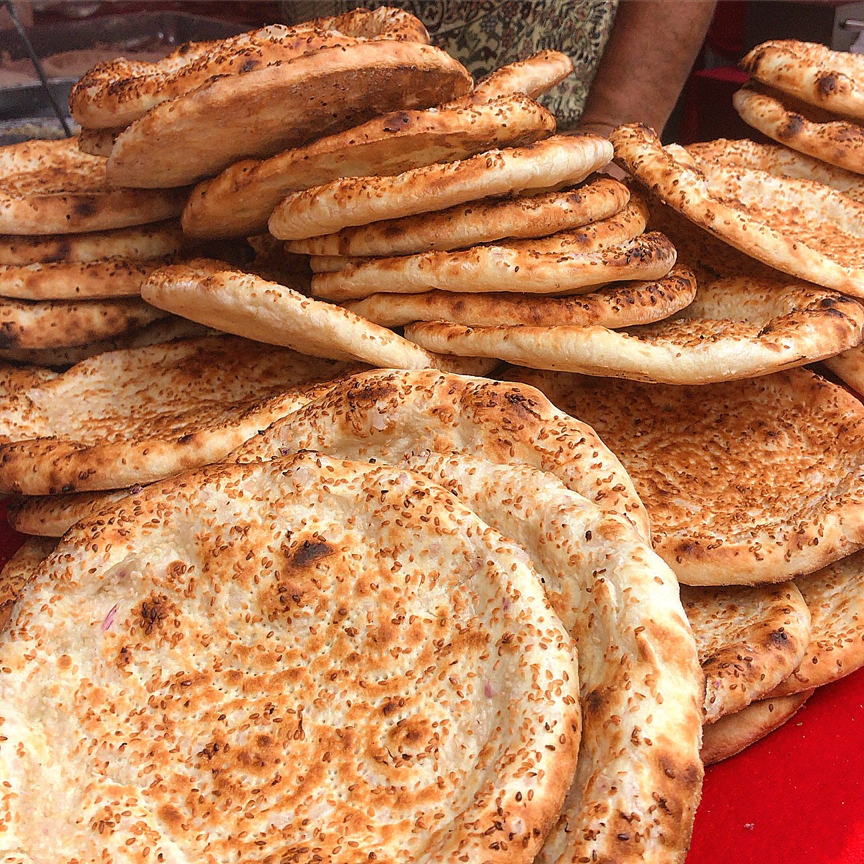
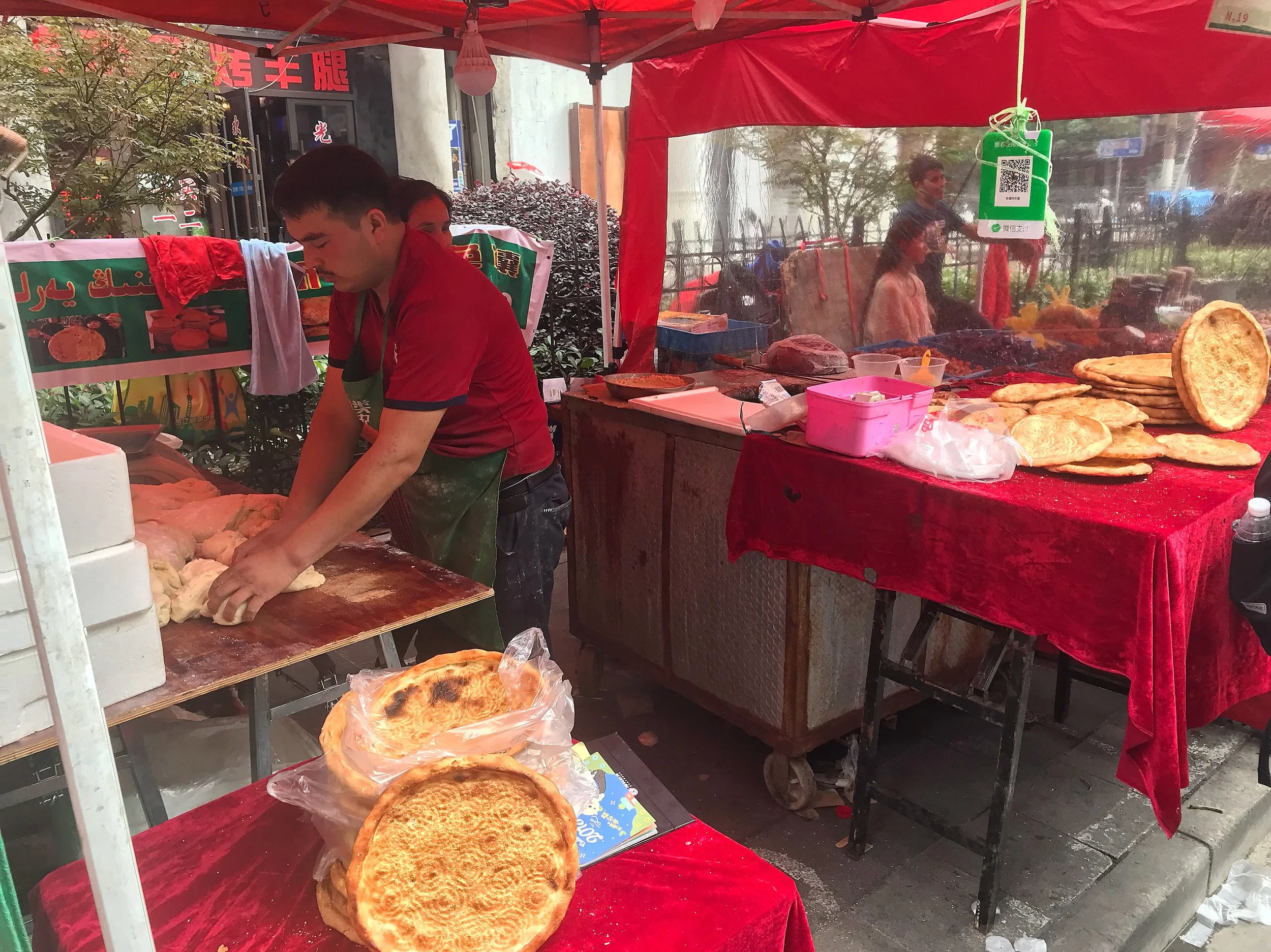
While I had spent much of the first week enjoying many of the traditional Shanghainese and Chinese dishes, many of which I had been familiar with, and many of them containing or being served with rice. It wasn’t until we had been there around a week and a half that I experienced a subculture of China and their cuisine, that my notions of what Chinese food could be had been fully restructured. On that Friday afternoon in June, our class walked the Shanghai streets until we approached a Muslim food market. A community, who I would later learn to be the comprised mostly of the Uyghur community most commonly from what is now the northwest of China, gathered in front of me to break bread and share food on what seemed to be their holy day. The Huxi Mosque, Shanghai’s most notable place of worship for the Muslim community, is located just a block away. On this street our class experienced, well for me at least, a very new perspective on the cuisine of China. Instead of the rice I had understood China to center their cuisine around, the Uyghur people seemed to feature various breads as a staple of their diet. Most commonly I observed the flat sesame bread being kneaded, baked, and sold just before my eyes (pictured from two different vendors both above and below). While the trope of China being a rice-eating culture is not necessarily untrue, it is rather an oversimplified assumption which is reductive of an existent and vibrant cultural foodway within China.
The Uyghur community, a Turkic ethnic group inhabiting East and Central Asia, remains mostly as one of the largest ethnic minority groups in what is now China’s Xinjiang region. In a report on the The Uyghur American Association, the association asserts,
"According to the latest Chinese census, the present population of these Muslims [in East Turkistan, a region in the southwest of Xinjiang, China] is slightly over 11 million; among these, the 8.68 million Uyghurs constitute the majority. However, Uyghur sources indicate that Uyghur population in East Turkistan exceeds 15 million."
Along with populations like the Tibetans, Uyghurs have been culturally suppressed in the years following their domination by a repressive Chinese regime. Reports such as that from BBC entitled “Why Is There Tension Between China and the Uighurs?” also detail that Uyghurs in Xinjiang have even been banned from fasting during Ramadan in various forms and at different periods. The community in Shanghai however is a much smaller population than that of Xinjiang, and exact population reports are hard to pin down (estimates are often in the thoustands).
As a descendant of survivors of the Armenian genocide myself, I struggle to contain my frustration when it comes to the suppression of any community due to their cultural background itself. In the case of the Uyghur community, I admit I began this trip not knowing about their existance whatsoever. Even upon my initial introduction to the community at their street food market in Shanghai, my take away was about the tasty bread they had (which truly was incredible) and the familir spice and aromatic utilization to that of my own Armenian maternal family cooks. Upon my arrival back home, and after further research of the Chinese Muslim and specifically Uyghur community itself, I feel concern for their wellbeing in the current geo-socio-political climate they are in. My true and honest hope is that the Chinese administration is able to take a lesson from the Uyghur community, and together move forward to break bread with one another.